
Nouvelle Vague
Director Richard Linklater's film recounts the making of Jean-Luc Godard's "Breathless," the definitive symbol of the French New Wave. A true homage to Godard: cinema's own "wandering Jew."

by Gabriella Serravalle
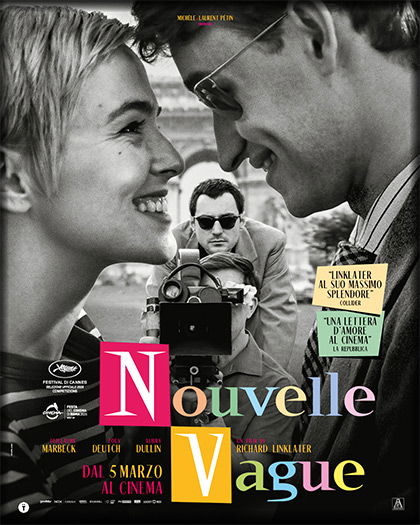
Nouvelle Vague, the new film by Richard Linklater, hits theaters on March 5 following its premiere in competition at the 2025 Cannes Film Festival. The film has already garnered one Golden Globe nomination, 10 César nominations (winning four), five Lumiere Award nominations (winning two), and an Independent Spirit Award nomination. Nouvelle Vague currently ranks 10th at the box office; on Sunday, March 15, it grossed € 50,514.00 with 50,147 admissions.
1959. The Nouvelle Vague is sweeping through Paris, as the first films by its proponents François Truffaut and Claude Chabrol achieve massive success. Jean-Luc Godard is convinced to shoot his first feature with the help of producer Georges de Beauregard. The result would be “Breathless,” a film destined to change the history of cinema forever.
Filming in French for the first time and with an almost entirely French cast, Linklater assembled a pitch-perfect ensemble, starting with a stunning and remarkably similar Zoey Deutch as Jean Seberg—complete with her mischievous look, cropped hair, and lean, elegant physique. Godard is played by near-newcomer Guillaume Marbeck, while Aubry Dullin delivers an excellent Belmondo. Adrien Rouyard embodies Truffaut, and Matthieu Penchinat portrays the brilliant cinematographer Raoul Coutard, whose background in war photography made him the perfect fit for this adventure.
Linklater revisits the famous and lesser-known faces of that era—Claude Chabrol, François Truffaut, Jacques Rivette, Robert Bresson, Agnès Varda, and even Rossellini, Bresson, and Melville—casting them with talented, relatively unknown actors. The most recognizable face is Zoey Deutch, who effectively captures Jean Seberg’s contradictions, attempting to look past the modern perception of the actress often colored by her tragic end.
Linklater does more than just tell an exemplary story in the most natural way possible. He explores the birth of one of the most iconic films in international cinema history: Breathless. Naturally, the set was filled with more uncertainty and surprises than conviction. Godard would frequently halt production when he ran out of ideas, claiming the freedom of thought and action that would define him as a great intellectual in later years.

Comments
No comments yet. Be the first to comment!